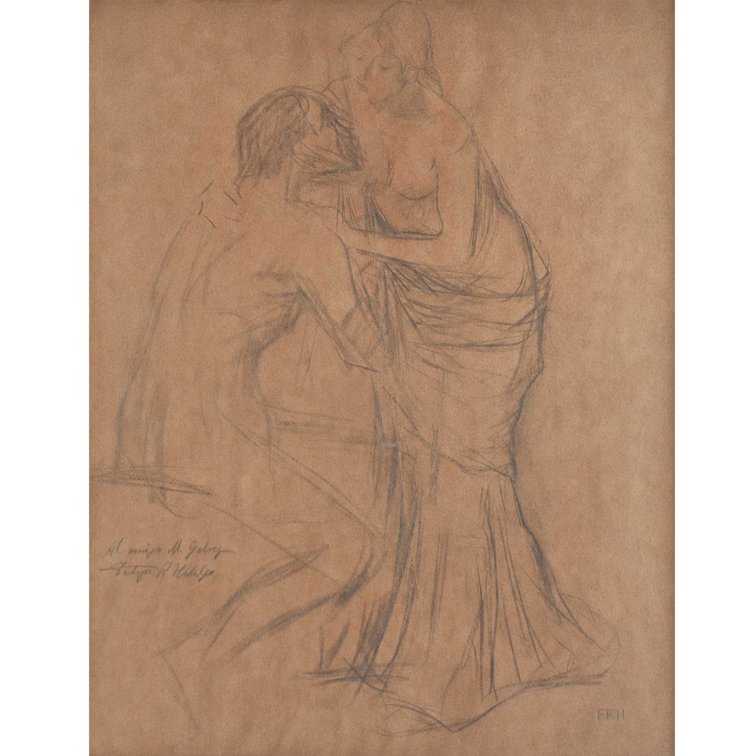
#35 • Félix Resurreción Hidalgo (1855–1913) - Study for an Allegorical Composition
Part of The Well-Appointed Life (live auction by Blue Box Auction Gallery)
Location: Makati City, MM
Status: PASS
Category: Wall Art
Bid with Salcedo Artist: Félix Resurreción Hidalgo (1855–1913) Title: Study for an Allegorical Composition Medium: Graphite on paper Dimension: 62 x 48 cm (24 1/2 x 19 in) Additional Information: Signed (lower right) and undated; Inscribed by Felipe Hidalgo to M. Gálvez on the obverse Félix Resurrección Hidalgo’s Study for an Allegorical Composition is a rare survival from the artist’s practice as a draftsman and painter of grand historical and allegorical subjects. Executed in graphite, the drawing reveals Hidalgo’s extraordinary command of line, gesture and tonal modulation. While the precise finished composition to which the study relates remains the subject of further research, its dense arrangement of forms and figures is consistent with the sustained preparatory process through which Hidalgo developed his major compositions. The drawing is animated by a constellation of organic and figurative forms gathered around a dominant central presence. Sweeping contours, repeated circular forms and carefully modulated areas of graphite create a remarkable sense of movement across the sheet. Hidalgo allows the paper to function as an active element of the composition, bringing luminosity to the central figure while the surrounding marks gradually recede and accumulate. The result is both exploratory and remarkably resolved. Hidalgo’s major historical and allegorical works were developed through extensive preparatory studies. Surviving drawings associated with La Barca de Aqueronte and Per Pacem et Libertatem demonstrate the importance he placed upon working through figures, gestures and compositional relationships in drawing before their translation into larger works. The present sheet belongs to this important aspect of his practice. Its provenance adds a further dimension. Inscribed on the obverse by Felipe Hidalgo, the artist’s nephew and an important custodian of his legacy, to the quite possibly the painter Miguel Gálvez, it provides direct material evidence of the drawing’s passage between two significant figures in Philippine art. The drawing subsequently entered the collection of the same distinguished collector couple who preserved National Artist H.R. Ocampo’s A Song for a Couple, as well as the 1930s Manila Carnival watercolor by National Artist Fernando Amorsolo and a work by Oscar Zalameda. The provenance therefore reflects a particularly discerning engagement with Philippine art across generations, encompassing not only major canonical figures but also works enriched by direct personal relationships between artists and collectors.