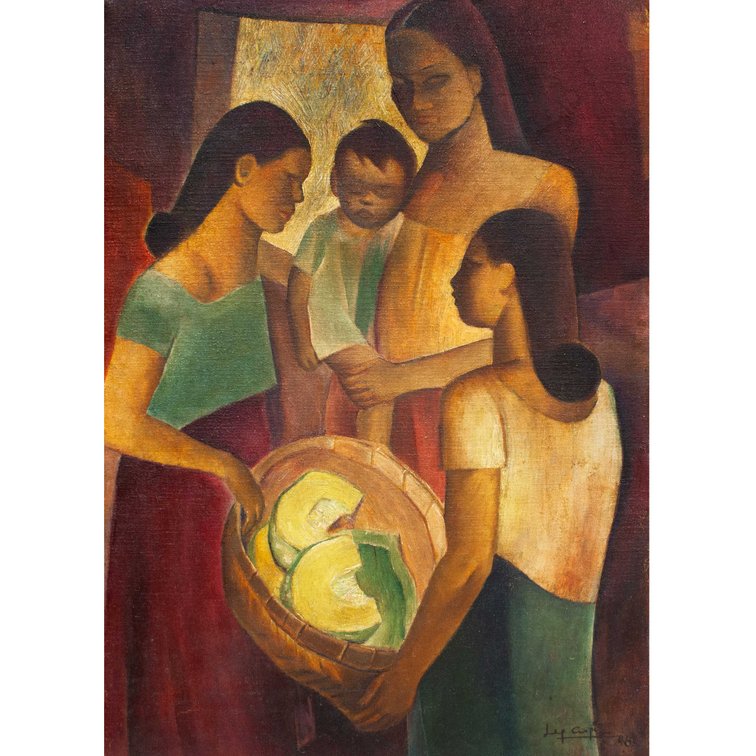
#26 • Cesar Legaspi (1917–1994) - Untitled
Part of The Well-Appointed Life (live auction by Blue Box Auction Gallery)
Location: Makati City, MM
Status: SOLD
Category: Wall Art
Bid with Salcedo Artist: Cesar Legaspi (1917–1994) Title: Untitled Medium: Oil on canvas Dimension: 55 x 39.5 cm (21 3/4 x 15 1/2 in) Additional Information: Signed and dated '48' (1948, lower right) Painted in 1948, this exceptional early work by National Artist Cesar Legaspi belongs to the formative period in which the artist helped establish the vocabulary of Philippine Neo-Realism. It is a painting of remarkable historical and aesthetic importance: rooted in the human realities of postwar Filipino life, yet articulated through a sophisticated modernist structure that moves decisively beyond academic representation. The subject is intimate and recognizably Filipino: a group of women and children gathered around a tray of food, their bodies arranged in a compact familial and social encounter. Yet Legaspi transforms this everyday scene through the deliberate organisation of figure, plane and colour. The four principal figures interlock almost as architectural elements, their elongated limbs and simplified anatomies creating a rhythmic vertical structure. Faces are turned inward, gestures overlap, and the circular tray provides a visual counterpoint to the angular construction of the bodies. The composition consequently possesses both intimacy and monumentality. This is precisely where Legaspi’s Neo-Realism becomes most compelling. Alongside his fellow National Artists, Hernando R. Ocampo and Vicente Manansala, he was among the principal postwar practitioners of a movement that retained representational subjects while opening them to distortion, abstraction and the expressive possibilities of modernist form. In Legaspi’s hands, Cubist principles become a means of intensifying human experience: bodies are constructed through planes and rhythmic contours, while colour establishes emotional and spatial relationships rather than simply describing appearances. The date is of particular significance. Works from the late 1940s represent the emergence of the mature modernist language that would define Legaspi’s contribution to Philippine art. Comparable works from this period, including Gadgets I (1948), Stairway (1948), and Wood Gatherers (1948), are documented in the National Commission for Culture and the Arts’ catalogue of works by National Artists. Rare in both date and quality, this painting is an important surviving document of Philippine postwar modernism. Its sophisticated structure, deeply human subject and assured synthesis of representation and abstraction make it a truly museum-quality example of Legaspi at a pivotal moment in the formation of Philippine Neo-Realism.