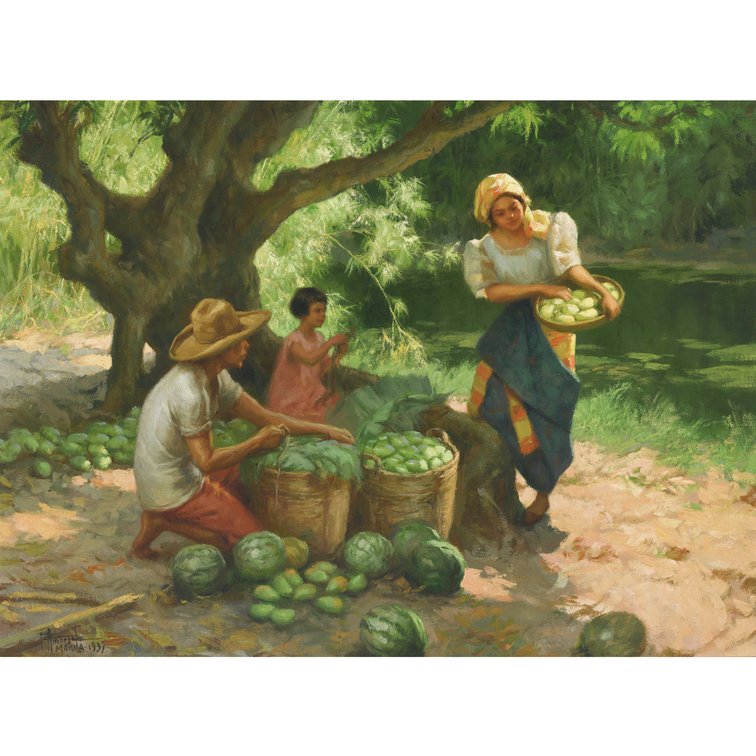
#25 • Fernando Amorsolo (1892–1972) - Under the Mango Tree
Part of The Well-Appointed Life (live auction by Blue Box Auction Gallery)
Location: Makati City, MM
Status: SOLD
Category: Wall Art
Bid with Salcedo Artist: Fernando Amorsolo (1892–1972) Title: Under the Mango Tree Medium: Oil on canvas Dimension: 48.3 x 66 cm (19 x 26 in) Provenance: Acquired by Dr. and Mrs. William Burget, Astoria, Oregon, circa 1965-1970; Thence by descent to the present owner, 1983; Private collection, Idaho, USA. Additional Information: Signed and dated '1937' (lower left) National Artist Fernando Amorsolo’s The Fruit Vendor (1939), Under the Mango Tree (1937), and the 1930s watercolor study for a Manila Carnival poster each offer a distinctive glimpse into the visual imagination of pre-war Philippines. Individually, they illuminate different facets of the artist’s celebrated Golden Period and of a Philippines at once pastoral, cosmopolitan and poised on the threshold of modernity. The accompanying Manila Carnival presentation situates these works within the sophisticated urban culture of 1930s Manila, when architecture, commerce, entertainment, fashion and social life were being transformed. The period is remembered in Filipino cultural memory as Peace Time—the years before the devastation of the Second World War. As one historian has observed, Amorsolo’s sunlit pastoral paintings possess an extraordinary capacity to transport the viewer to the pistaym, an imagined world of pre-war innocence, abundance and optimism. It is this atmosphere that makes these works such evocative records of their era. The Fruit Vendor is particularly remarkable for both its subject and composition. At its centre is the archetypal Dalagang Bukid, Amorsolo’s idealised Filipina: graceful, self-possessed and warmly smiling as she carries a tray of tropical fruit. Yet rather than presenting her as an isolated emblem of rural beauty, Amorsolo places her in animated exchange with another country lass. Their encounter gives the composition an unusual sense of sociability and narrative. Their costumes—richly patterned patadyongs, colourful saya, white baro and vividly tied headscarves—introduce passages of red, yellow, blue and green, all transformed by the warm sunlight filtering through the trees. Under the Mango Tree expands Amorsolo’s vision of rural abundance into a richly composed tableau. Beneath the great spreading canopy, workers gather around baskets overflowing with mangoes, while the Dalagang Bukid approaches carrying another abundant tray. The composition moves rhythmically between the monumental tree, the seated figures, the baskets of fruit and the standing woman, creating an elegant equilibrium between shade and sunlight, repose and activity. Amorsolo’s golden illumination does more than describe the tropical environment: it idealises the human figures, making their faces, clothing and gestures glow against the surrounding greenery. The 1930s watercolor study for a Manila Carnival poster provides a fascinating urban counterpart. Its exuberant procession of elaborately costumed figures, rendered in brilliant greens, oranges, yellows and reds against a deep blue ground, captures the Carnival’s theatrical glamour and cosmopolitan energy. The Carnival encompassed grand balls, parades, fashion, theatrical performances and exhibitions, while its Queens served as society figures, fashion figures and cultural representatives. Amorsolo himself designed a Carnival poster early in his career and became involved as a judge of its beauty-queen contests, an association that helped establish his national prominence. Taken individually, each work captures a different aspect of Amorsolo’s vision: the grace of the Filipino woman, the abundance of the countryside and the spectacle of an increasingly sophisticated Manila. Together only in historical context, they evoke the colour, confidence and optimism of a vanished Philippine Peace Time—when rural life, urban modernity and the ideal of Filipino beauty were all being imaginatively shaped by one of the country’s greatest painters.