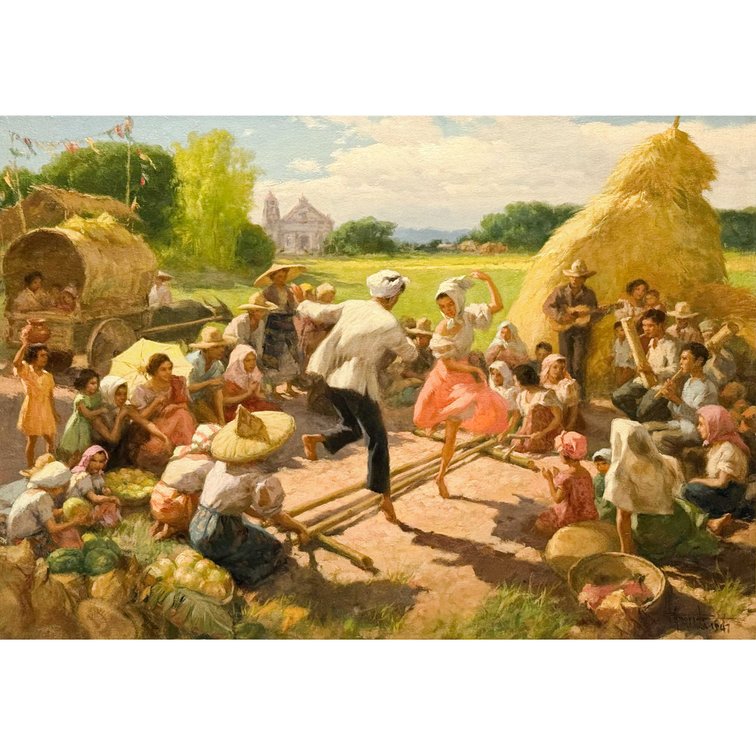
#50 • Fernando Amorsolo (1892–1972) - Tinikling Dance
Part of The Well-Appointed Life (live auction by Blue Box Auction Gallery)
Location: Makati City, MM
Status: Sold
Category: Wall Art
Bid with Salcedo Artist: Fernando Amorsolo (1892–1972) Title: Tinikling Dance Medium: Oil on canvas on board Dimension: 63.5 x 88.9 cm (25 x 35 in) Condition: Glossy varnished surface; visible surface texture; no paint loss; no damage or warpage; canvas remains bound tight to board. Provenance: By direct family descent from Dr. Darrell O. Overpeck to the present owner, Virginia, USA; This lot is presented in association with Blue Box Auction Gallery, Virginia, USA Additional Information: Signed and dated '1947' (lower right) Fernando Amorsolo’s Planting Rice (1945) and Tinikling Dance (1947) belong to a particularly significant period in the artist’s career: the years surrounding the end of the Second World War, when the Philippines was emerging from extraordinary destruction and beginning the long process of reconstruction. Both paintings return to subjects that had long occupied Amorsolo’s imagination—agricultural labour, communal celebration, music and the rhythms of rural life—but their dates lend these familiar themes a deeper historical resonance. They present the countryside not simply as picturesque scenery, but as a repository of continuity, cultural memory and national identity. In Planting Rice, Amorsolo depicts farmers transplanting seedlings across a flooded paddy, their bent figures reflected in the water beneath a softly illuminated sky. The composition unfolds through successive planes of figures, trees, thatched structures and distant mountains, creating a measured rhythm across the landscape. A musician appears among the workers in the distance, an understated detail that introduces the sound and sociability of rural life into an otherwise contemplative scene. The mirrored water and luminous atmosphere exemplify Amorsolo’s celebrated ability to transform agricultural labour into a poetic vision of the Philippine countryside. The work’s 1945 date is especially poignant: painted in the final year of the war, its vision of cultivation and renewal assumes an almost allegorical dimension. Tinikling Dance, painted two years later, shifts from labour to celebration. At its centre, a young couple performs the traditional dance amid an expansive gathering of villagers, musicians and children. Around them are baskets of produce, haystacks and the abundant landscape, creating a scene in which music, movement and harvest converge. The dancers’ animated gestures and the surrounding spectators generate a sense of collective participation, while Amorsolo’s characteristic sunlight unifies the entire composition. Here, the rural community becomes a stage—not for spectacle imposed from outside, but for a culture actively expressing itself through dance, music and shared ritual. Together with the 1930s works of The Well-Appointed Life, these paintings extend Amorsolo’s vision beyond the remembered glamour of Peace Time into the period of wartime rupture and postwar renewal. If his earlier pastoral paintings evoke an idyllic pre-war Philippines, these later works demonstrate the persistence of the very traditions that gave that earlier vision its meaning. Planting Rice and Tinikling become complementary expressions of continuity: one rooted in the sustenance of the land, the other in the communal rituals of Filipino life. Their significance is further heightened by their exceptional provenance. Both paintings descended through the family of Dr. Darrell O. Overpeck, an American military orthopedic surgeon who served in the Pacific and in the Philippines during the war. According to the documented family history, Overpeck treated Amorsolo’s wife while stationed in the Philippines and subsequently acquired works directly from the artist; the paintings remained in the family for generations. Rarely encountered with such a combination of date, subject, scale, authentication and uninterrupted family descent, Planting Rice and Tinikling Dance are important records of Amorsolo’s enduring vision of the Filipino countryside. Painted at a pivotal moment in the nation’s history, they affirm his extraordinary capacity to make the familiar luminous—and to invest everyday Filipino life with the dignity of national memory.