#81 • Barber Silver Coinage
Part of The Gold Standard Auction: Rare Coins & Bullion (live auction by Blue Box Auction Gallery)
High bid $140.00
Status: SOLD
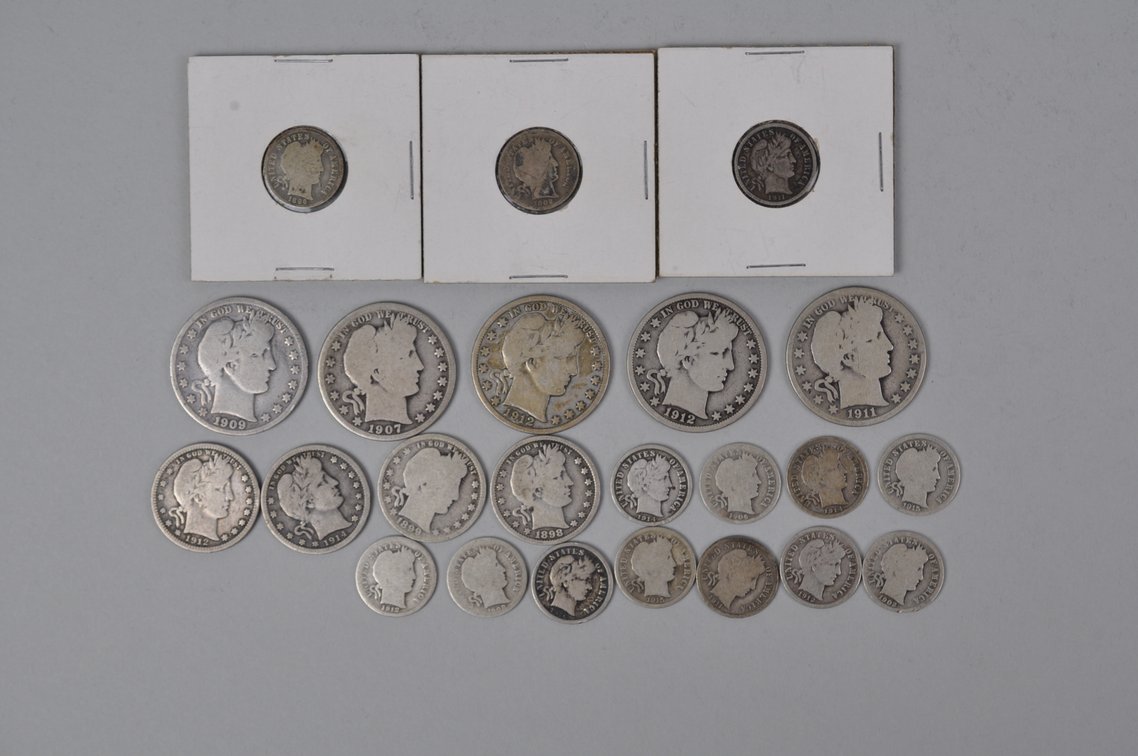
Estimated Value: $80-120 Origin: United States Denomination: Fourteen One Dime, Four Quarter Dollar, and Five Half Dollar Year: One Dime1896,1902,1906, 1908, 1911-1912, 1914-1915; Quarter Dollar 1898-1899, 1912, and 1914; Half Dollar 1907,1909,1911-1912 Mint: One Dime 1896, 1902, 1906, 1908 Philadelphia; 1911 Philadelphia, Denver; 1912 Philadelphia; 1914 Philadelphia, Denver; 1915 Philadelphia. Quarter Dollar 1898-1899, 1912, 1914 Philadelphia; Half Dollar 1907 New Orleans; 1909 San Francisco; 1911 Philadelphia; 1912 Philadelphia, San Francisco Grade: Various Conditions Metal: Silver Weight: 123.8 total some with sleeve protectors Additional Description: The Barber Dimes from 1896, 1902, 1906, 1908, 1911, 1912, 1914, and 1915 reflect the steady, workhorse character of Charles E. Barber’s design—a neoclassical Liberty conceived more for utility than artistic flair. Struck during a time of economic recovery and growth, these coins were minted in large numbers and widely circulated, their modest relief showing wear quickly in everyday use. The earlier dates coincide with post-recession stability, while the later issues edge toward the end of the series, just before the Mercury Dime replaced it in 1916. The Barber Quarter Dollars of 1898, 1899, 1912, and 1914 come from both the heart and the later years of a series defined by restraint and durability. Designed by Charles E. Barber and introduced in 1892, the quarter was part of a broader redesign of American silver coinage, favoring classical simplicity over decorative excess. The 1898 and 1899 issues reflect a time of robust mint activity following the economic recovery from the Panic of 1893, with coins widely used in daily commerce. By 1912 and 1914, the Barber quarter was showing its age. Though still produced in substantial numbers, the design—functional and familiar—had begun to feel dated in an era leaning increasingly toward artistic expression in coinage. The Barber Half Dollars of 1907, 1909, 1911, and 1912 represent the middle years of a series that, while often understated in style, played a steady and essential role in American coinage during the early twentieth century. Designed by Chief Engraver Charles E. Barber and first issued in 1892, the half dollar followed the same classical template as its dime and quarter counterparts, featuring a dignified Liberty in profile crowned with a laurel wreath. By 1907, the design was well established, and production was routine across multiple mints, serving a growing economy in the wake of the Gilded Age. The 1909 and 1911 issues continued this momentum, minted in response to consistent demand and used heavily in everyday commerce. By 1912, as reformist energy stirred in American politics and modern artistic movements gained ground, the Barber series began to feel increasingly conservative in style. Still, these half dollars, with their solid weight and restrained elegance, remained trusted instruments of exchange, bridging the space between late Victorian formality and the more expressive coinage that would follow.